|
It was obvious that even after we've got the floor and walls and heat and electricity and all that nice stuff in, the studio will still need some acoustic treatment to sound good.
First, both the length and the width were just about 20 feet. It's a bad idea to have a room share two similar dimensions (such as being 8 feet wide and having an 8 foot ceiling). This is because of modal resonance in the room. While there's lots of great stuff on the internet about this acoustic principle, I'll give the very simplified explanation here.
Sound waves reflect off the physical surfaces that they encounter, like walls and floors. Waves that measure the width of a room, for example, will amplify and die out differently than those that are longer or shorter than that width. So a low C note, which may complete its wave cycle in x feet, will sound different in a room that is x feet wide than it will in a room that is y feet wide. Since this is very difficult to avoid, it's best to spread out what notes are behaving oddly in a room. Keeping the walls, floor and ceiling in good relative proportions helps to soften the odd effects that the room contributes to the sound inside it.
For this reason, we decided on a ratio of 1:1.28:1.54. This allowed us to keep the 12 foot ceiling, and fortunately the long wall was almost exactly 18.48 feet. To change the third dimension, we've added a bunch of shelves that are covered by thick, insulated doors. This should do pretty good job of matching desired ratios. The shelf construction will be very robust, as we want to minimize any effect of the shelf "chamber" on screwing up the noise further.
Second, we had to decide whether or not to change the walls. There are some schools of thought that argue strongly that studios must always avoid having parallel walls facing each other. The argument says that by "splaying" the facing surfaces, the effects of modal resonance are lessened, and sound is spread out the room more favorably. After reading a lot and thinking long and hard, we decided to skip this. Some acousticians feel that splaying surfaces only makes the problem of dealing with modal resonance more difficult to treat. While we still feel there's lots of compelling information on the "splay the walls" side, it seemed more prudent to make use of what floor space we could and treat the room after construction.
After the room was built, we worked on treating it with bass traps. The original plan was to also include treatment with diffusors, but we got impatient after three years and wanted to be done with it. So there's still room for some improvement.
Finally, we will be using the room most often for scratch recording, practicing and as a place to work out ideas. For this reason, we don't need to run the room like the Hit Factory. Most recording studios have a "live room" (where the acoustic sound is generated, such as a musician playing an instrument) and a "control room" (where the person who is engineering the recording can listen to what is being recorded). This separation is important, as it's tough to hear whether or not a microphone is picking up a drummer clearly when the guy is wailing away in the same room that you are in. For those times when this acoustic separation is necessary, we've installed conduit running from the studio to the basement of the house nearby. We can run a microphone snake to the basement, and the separation between the two rooms will be excellent. The drawing over to the right gives a simple idea of how this works. It's not totally clear yet how we're going to bring the 300 lb. tape machine back and forth, but I'm sure we'll figure that out.
|
 |
|
|
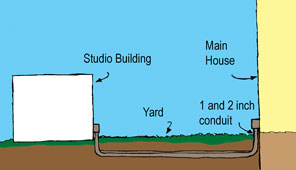
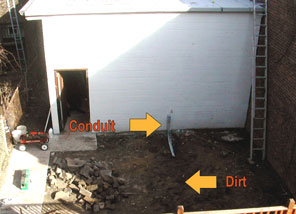
Burying the two types of conduit in the backyard. This has all been covered over by grass. The ladder is set up to get the tennis balls that have been thrown on the roof.
| |
|
|
[ LATEST UPDATE ]
[ Archives ]
CONSTRUCTION
[ Overview ]
[ Basic Construction ]
[ Acoustics ]
[ HVAC ]
[ Electrical ]
[ The Grand Vision ]
[ Tool Reviews ]
[ Links and Resources ]
|

 NEWS . JOURNALS . SHOWS . CONTACT . BIOGRAPHY . AUDIO . MERCH . LABEL . BANDCAMP . FACEBOOK . TWITTER